



Selling a pharmacy in Ireland is one of the most significant financial decisions a pharmacist will ever make. Unlike selling most other businesses, a pharmacy sale involves a unique combination of corporate law, professional regulation, property considerations and healthcare contracting, all of which must be carefully managed to achieve a smooth and successful outcome.
This guide walks through the full process, from getting your pharmacy valued to completion, including the PSI registration requirements that catch many sellers off guard. Whether you are planning a sale in the near future or simply thinking ahead, understanding the process early gives you a real advantage.
Note: this guide is intended for general information purposes only and does not constitute legal or financial advice. Always consult a solicitor and accountant experienced in pharmacy transactions before proceeding.
1. How is a pharmacy valued in Ireland?
Before anything else, you need to know what your pharmacy is worth. Valuation is the foundation of the entire sale process, it sets expectations, informs negotiations and determines how buyers will structure their financing.
In Ireland, pharmacies are primarily valued on a multiple of maintainable EBITDA, earnings before interest, tax, depreciation and amortisation. This reflects the pharmacy’s underlying capacity to generate profit on an ongoing basis, stripped of one-off items and owner-specific costs.
According to Fitzgerald Power, a specialist pharmacy advisory firm, Irish pharmacy assets generally achieve EBITDA multiples of between 4x and 6x, adjusted for relevant net assets at completion, including stock, debtors, working capital and tax liabilities. This makes pharmacy an outlier compared to most SME sectors, where net working capital is typically included within the EBITDA multiple rather than treated separately.
The key drivers of where a pharmacy lands within that range include:
- Location and footfall: a well-positioned pharmacy in a high-demand area commands a premium.
- Turnover and profit margin: higher, consistent revenues attract stronger multiples.
- Dependency on the owner: a pharmacy that runs without heavy reliance on the owner-pharmacist is more attractive to buyers.
- Lease quality: a long, secure lease is essential; a short or uncertain lease term materially reduces value.
- Growth potential: adjacencies, underserved services, or expansion opportunity add to the case for a higher multiple.
- GMS/HSE contract: the value of the State dispensing contract is a core component of pharmacy goodwill.
Before going to market, it is strongly advisable to commission a professional valuation from an advisor experienced in pharmacy transactions. This ensures you enter negotiations with a realistic and defensible view of value.
2. How a pharmacy sale is structured
Most pharmacy sales in Ireland are structured as share sales rather than asset sales. This means the buyer acquires the shares in the company that owns and operates the pharmacy, rather than buying the individual assets of the business.
The share sale structure has important implications for both parties. For the seller, it is often more tax-efficient. For the buyer, it means assuming all of the company’s existing liabilities, which is why thorough due diligence is critical.
One of the most important elements of the sale structure is the property. Most Irish pharmacies operate under a lease, and the terms of that lease, its length, rent review clauses, and assignability, are central to the value of the business. A buyer needs certainty and security over the premises to feel confident in the investment.
3. Finding a buyer and agreeing heads of terms
Buyers come from several directions. Pharmacy groups and chains are actively acquiring independent pharmacies across Ireland. Private equity-backed buyers have also entered the market in recent years. There are also individual pharmacists looking to acquire their first or second pharmacy.
Most sellers engage a broker or corporate finance firm to bring the opportunity to market confidentially, manage the process, and run a competitive process to maximise value. Some sales are agreed directly between parties who already know each other.
Once a buyer is identified and both parties agree on a broad outline of the deal, Heads of Agreement are drawn up. These are typically non-binding but set out the key commercial terms, the proposed price, payment structure, conditions and any exclusivity period. They provide a framework for the legal and financial due diligence that follows.
4. Due diligence: what buyers will examine
Once Heads of Agreement are signed, the buyer’s legal and financial teams begin a thorough due diligence process. This is where many pharmacy sales run into delays because documents are missing, out of date or harder to locate than expected.
Sellers who prepare their documentation in advance move faster and signal professionalism to buyers. The key items to have ready include:
-
- Statutory books and company records, fully up to date.
- Signed employment contracts for all staff.
- PSI Certificate of Registration.
- HSE GMS contract.
-
- Copies of all supplier purchasing agreements.
- Lease agreement and any correspondence with the landlord.
- Hire-purchase or lease agreements for equipment (tills, prescription management systems, etc.).
- Data protection policy and GDPR compliance documentation.
- Current insurance schedules.
- Employee schedule including pay rates and any non-statutory entitlements.
- Three years of audited accounts and recent management accounts.
- Planning permissions and any relevant property documentation.
The buyer’s solicitor will pay particular attention to the lease, reviewing its terms, checking that no Deed of Renunciation has been signed (which could affect the pharmacy’s lease rights under the Landlord and Tenant Acts), and confirming that planning permissions are in order.
5. The PSI registration: the step that surprises most sellers
This is the area that most frequently catches pharmacy sellers off guard, and getting it wrong can have serious consequences including the forced closure of the pharmacy.
PSI registration does not transfer automatically
A pharmacy’s registration with the Pharmaceutical Society of Ireland (PSI) is tied to its current ownership structure. When ownership changes, the existing registration is cancelled and the new owner must apply for a fresh registration.
Specifically, under Section 17 of the Pharmacy Act 2007, a change of ownership is triggered when a company transfers more than 50% of its shares to a new or existing shareholder, either in a single transaction or cumulatively since the pharmacy was first registered with the PSI. When this happens, the existing registration is automatically cancelled 28 days after the date of the share transfer.
The PSI must be notified in advance
It is a legal requirement under the Pharmacy Act to notify the PSI of any change in ownership. Failure to do so, and continuing to operate after registration has been cancelled, is a criminal offence. The PSI is clear: if a pharmacy operates without valid registration, it will be closed until a new registration is processed.
Sellers should contact the PSI before the sale completes, giving sufficient time for the new registration application to be processed. The PSI has indicated it will work with parties to ensure continuity of trading where sufficient notice is given.
Re-registration application must be submitted at least 60 days in advance
Applications for first-time registration (which is what a change-of-ownership triggers) must be submitted to the PSI at least 60 days before the pharmacy is due to be registered and open under its new owner. Late applications incur additional fees and risk delays.
The PSI registration fee for a change of ownership is €3,325.
The HSE contract does not transfer either
The pharmacy’s GMS (General Medical Services) contract with the HSE is also personal to the current owner and does not transfer to the buyer. Both the PSI registration and the HSE contract must be terminated and renewed in the name of the new owner on completion.
Both processes should be initiated well in advance of completion to avoid any gap in the pharmacy’s ability to dispense on behalf of GMS patients.
6. The legal documentation
In a share sale, the core legal document is the Share Purchase Agreement (SPA). This sets out all the terms of the transaction, including:
- The purchase price and payment structure.
- Conditions that must be satisfied before completion.
-
- Warranties: legal assurances given by the seller about the state of the business.
- Indemnities and protections for the buyer.
- A Tax Deed of Covenant, dealing with tax liabilities that may arise after completion.
From the seller’s perspective, the warranty negotiation is critical. Sellers should work closely with their solicitor to negotiate appropriate caps on their liability, and to ensure all relevant matters are properly disclosed in the Disclosure Letter. A thorough disclosure process is the seller’s primary protection, anything disclosed cannot later be the basis for a warranty claim.
7. Completion accounts and net assets
In most Irish pharmacy transactions, the purchase price is based on an estimated net asset value at the time Heads of Agreement are signed, which is then adjusted once the sale completes through a completion accounts process.
Net assets typically include stock, debtors, working capital cash, and trade creditors. Any surplus net assets above the agreed estimate generally belong to the seller and form part of the overall consideration. This makes it essential for sellers to take financial advice on how to structure and optimise this element of the transaction.
The seller’s financial advisors prepare and negotiate the completion accounts post-sale, so having experienced advisors who understand pharmacy transactions is important. This is not an area to leave to a generalist accountant unfamiliar with the sector.
8. Tax considerations for sellers
The tax treatment of a pharmacy sale depends on how the transaction is structured, the seller’s personal circumstances, and whether reliefs such as Retirement Relief or Entrepreneur Relief are available.
Retirement Relief (under Section 598/599 of the Taxes Consolidation Act 1997) can allow an individual disposing of business assets to reduce or eliminate the capital gains tax liability, subject to conditions including age and the period of ownership. Entrepreneur Relief reduces the CGT rate from 33% to 10% on qualifying gains up to €1 million.
Whether either relief applies, and how to structure the transaction to optimise the tax position, is something that must be discussed with a tax advisor well before heads of terms are agreed. Restructuring after the fact is often not possible.
9. Common mistakes to avoid
Based on how pharmacy sales typically unfold in Ireland, the most common issues that cause delays or erode value are:
- Starting the PSI and HSE notification process too late: always engage both bodies well in advance of completion.
- Lease uncertainty: a short remaining lease term or an unresolved rent review can create a serious problem late in the process. Address property issues early.
- Poor record-keeping: missing employment contracts, outdated statutory books, or absent planning documents slow due diligence and raise red flags for buyers.
- Over-reliance on the selling pharmacist: if the business depends heavily on the owner’s relationships, buyers will discount the price to reflect the risk of patient attrition post-sale.
- Insufficient tax planning: leaving the tax conversation too late can significantly reduce the net proceeds of the sale.
- Choosing advisors without pharmacy experience: a solicitor or accountant unfamiliar with pharmacy transactions may miss sector-specific issues that an experienced advisor would catch immediately.
10. Before you sell: making your pharmacy more valuable
If a sale is on the horizon but not imminent, there are practical steps that can improve the value of the business:
- Invest in your online presence: pharmacies with strong local visibility and digital channels attract more patients and command better goodwill.
- Diversify revenue: reducing dependence on GMS dispensing and growing OTC, health services, and private income strengthens your multiple.
- Secure your lease: negotiate a lease extension well before the sale process begins.
- Systemise operations: document processes, ensure the business runs without your constant presence, and demonstrate it can trade successfully under new ownership.
- Clean up the books: normalise accounts to remove personal expenses and one-off items so that maintainable EBITDA is clearly visible.
One often overlooked area is online sales. Pharmacies that sell pharmacy products through delivery platforms like Uber Eats, Just Eat and Deliveroo demonstrate digital capability and an additional revenue stream, both of which can be attractive to buyers assessing future growth potential.
LUDA Partners connects Irish community pharmacies to Uber Eats, Just Eat and Deliveroo through a single integration, handling catalogue setup, updates and optimisation, with no fixed fees and minimal workload for your team. Find out how it works.
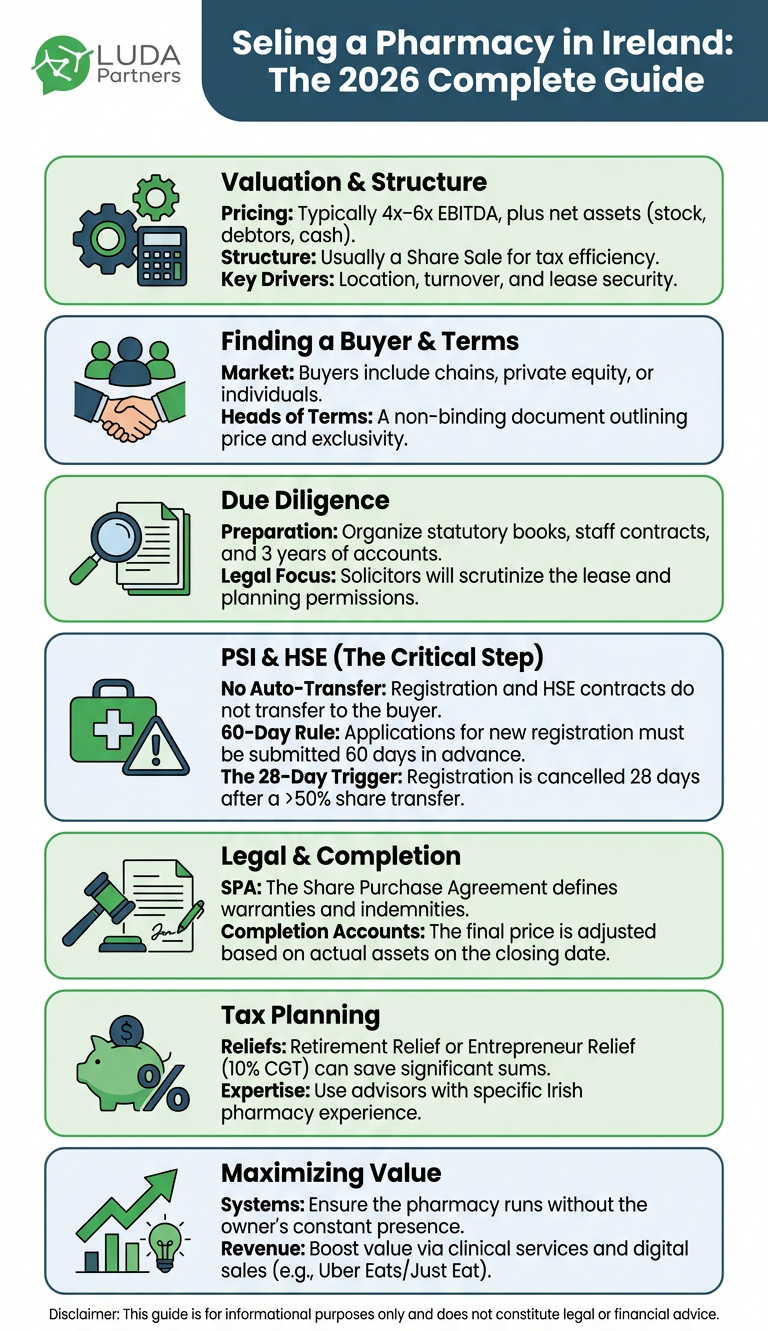
Key takeaways
- Irish pharmacies are typically valued at 4-6x maintainable EBITDA, adjusted for net assets at completion.
- Most sales are structured as share sales, the buyer acquires the company, not just the assets.
- PSI registration does not transfer to the new owner and must be re-applied for at least 60 days before the sale completes.
- A share transfer of more than 50% automatically cancels the pharmacy’s PSI registration 28 days after the transaction, notify the PSI in advance.
- The HSE GMS contract also requires separate renewal in the new owner’s name.
- Thorough disclosure and experienced advisors are the seller’s best protection in the warranty process.
- Tax planning, including Retirement Relief and Entrepreneur Relief, should begin well before heads of terms are agreed.